For my friends.

The reason for this blog is twofold. Firstly, to share my wonderful experiences with you at your leisure and to keep me feeling in touch with you during my long absence from home. If any of you find a way to type an Aussie accent, I would be really appreciative! Don't forget to check out "older posts" at the bottom.

Welcome to my blog. I hope you enjoy it from time to time.

Carmel

Friday, October 15, 2010

Gallipoli.

Like tens of thousands of other Australians, I made the pilgrimage to Gallipoli when I visited Turkey. Gallipoli (Gelibolu) was the site of some fierce fighting in World War 1. The Turkish soldiers were defending their country while the British, French Australian and New Zealand soldiers were fighting for the Allies and trying to break through the Gallipoli Peninsula to gain control of the Dardanelles and, hence, supply routes through the Sea of Marmara and the Black Sea. It must have seemed such a small area to battle across but a combination of Turkish determination and Allied strategic mistakes turned this battle into a significant episode in the history of Turkey, Australia and New Zealand and resulted in a long lasting respect and friendship between the countries. The campaign lasted from March 1915 to January 1916 and resulted in many deaths on both sides and many instances of bravery and compassion. For the people of Turkey, Australia and New Zealand, it is the stuff of legend and is relived every year on ANZAC Day in the antipodes and most days on the Gelibolu Yarimadasi.


And so I went to Gallipoli to see where all of this happened. It was cold and wet when we left the hotel in Istanbul (and early too) but, by the time we arrived at the Peninsula at lunchtime, it was hot and sunny. It was a very long day as I didn’t arrive back at my hotel until after 11.00 pm. Our guide was a young Turkish man who had made a study of the Gallipoli campaign from both sides of the war. His enthusiasm was contagious and his knowledge of dates and numbers and strategies was astounding and I wish I could remember some of them. No notes, no remember. However, all the names of places that we remember are all quite close geographically and it bears testament to the ferocity of the fighting in the Gallipoli campaign.


I expected to be extremely moved by what I saw at all the different sites but, try as I may, I couldn’t. I couldn’t because it was a picture perfect day. The sun was bright, the water was clear and blue, the ridges and valleys were covered with lush greenery and it was quiet and peaceful. In fact, it struck me, that if it wasn’t a memorial site it could easily be a seaside resort – it is that beautiful.


I couldn’t marry what I had seen and read in books and seen on TV with what was concrete before my eyes and under my feet. I saw the cemeteries. I saw the memorials. I saw the statues, the trenches and the tunnels dug by the “Diggers”. I saw how close enemy trenches were. I saw the ridges the diggers were ordered to climb and conquer. I heard the facts. It just didn’t add up at the time.

But now that I’m home, it’s starting to sink in that I was really there where all those young men fought, lost their lives and dug in for what was a hopelessly mismanaged campaign. I now have a much deeper appreciation, thanks to our guide, of both sides of the story and how difficult it was for everyone involved and what the “Gentleman’s War” means. I also have a new appreciation of the dreadful sacrifices made by the Maori soldiers of New Zealand at Gallipoli.

We visited the joint Turkish and ANZAC Memorial and Museum at Kabatepe with a magnificent outlook to the Aegean.

We stood in trenches and beside tunnels.


We saw Lone Pine and Suvla Bay.

Lone Pine.

Suvla Bay.


There was Simpson’s grave and Shrapnel Gully where he distinguished himself. However, when he was rescuing the wounded it was bare of foliage with Turkish snipers on one side of the valley.


Shrapnel Gully.

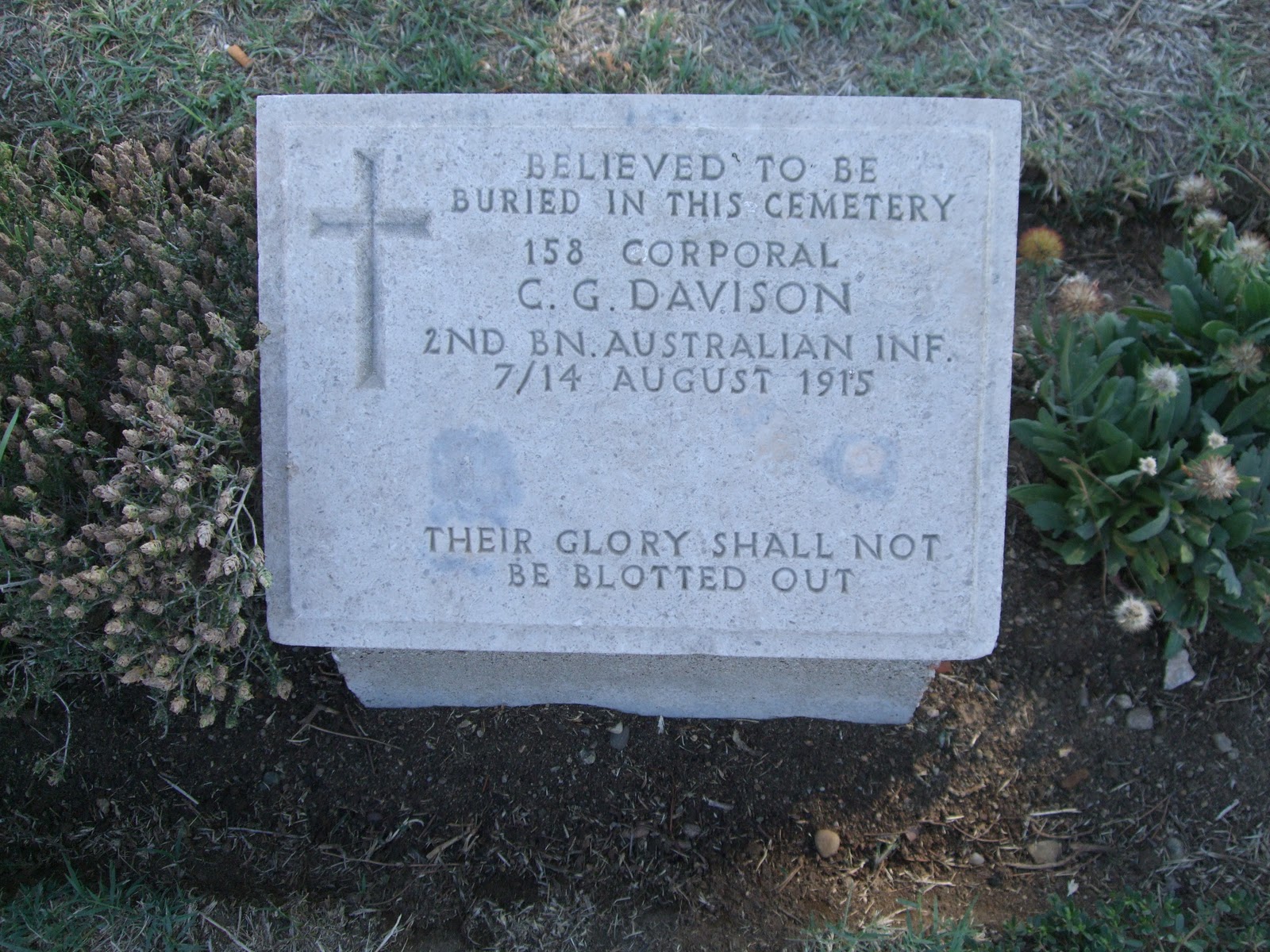
For some, the fighting was so fierce, no one was sure of when they died.

When did he die?


We stood at the place where whole families of Maori soldiers gave their lives to win a hill only for it to be lost later.


And close by the trophy, the Dardenelles.


Dardenelles over the hill.


Some relics.


And then when the horrors of Gallipoli were finished, the survivors went to the Western Front ......

Tuesday, October 12, 2010

Cats in Turkey.

One of the first things I noticed when I started exploring Istanbul was the cats.  Cats everywhere and with no obvious home.  After a few days, I noticed people in parks emptying whole bags of dry cat food in different parts of parks.  Then I learned that some businesses adopt cats and feed them and allow them to come into the shops and so you find homeless cats enjoying the air conditioning on hot days.  Then it occured to me that very few of the cats looked thin and scrawny whereas the few dogs I saw wandering around didn't look very healthy.

I'm not sure why this is so but homeless cats seem to be tolerated and even cared for around Turkey.  And you find them in the most amazing places ............

Kebab please.

What does he want me to do?


Siesta time.

Do I look regal in these ruins?

No I don't eat mints!

I'm waiting nicely.
Mum & kittens in the shade.
Who needs a scarf?
Next: Beautiful Antalya

Sunday, October 10, 2010

Ceramics.

After carpets and kilims, Turkey’s ceramics are famous for their beauty and perfection and are popular souvenirs. I had certainly checked out ceramics in Istanbul but I needed to learn a little about them and to see a variety of qualities and prices. There are endless shops with pottery and ceramics of all shapes and sizes and prices but I soon tired of looking at the same thing over and over again and started to be a little more discerning. I was on the hunt for one or two tiles and I wanted some orange in them. I didn’t realize how difficult that would be. There are few pieces with orange on them. I was also keen to see as many truly beautiful pieces as I could.


In Cappadocia, we visited a beautiful ceramic studio in Avanos. I felt as if I had discovered Aladin’s Cave. In fact, the factory is in a cave. We were given a demonstration of making a piece on a wheel and shown some magnificent pieces from the factory. We walked through the studio where master craftsmen/women were hand painting intricate pieces. Oh to have the patience and steady hand to be able to produce such things.


Oh happy day, so many beautiful things in one place. Although I couldn’t afford the tile I wanted (about $240 AUS), I can remember it. Truly beautiful.


I continued searching without any luck. There are plenty blue and white tiles similar to the Iznik tiles and with beautiful patterns but that’s not what I wanted. I wanted something with a touch of orange on it. I had seen some in Istanbul and had them in the back of my mind but was hoping to find something that really caught my eye and budget.

We were on the last leg of our trip around Selcuk and had made the rounds of a leather factory, an onyx factory, a jewelry factory and it seemed as if we wouldn’t have time to visit the ceramic factory. I had resigned myself to revisiting the shop in Istanbul and hoping their range included something close to what I wanted or even giving the whole thing a miss. After all, life can continue quite happily without a Turkish tile. We were asked if we wanted to visit the ceramic factory and I said a very definite “Yes!” and off we went leaving others to buy up on leather goods. It was Aladin’s brother’s cave, full of striking things and a wall full of superb tiles and a couple of them with orange on them. After all my searching, I thought it would be easy to make a decision but I couldn’t and it was time to leave. So I decided to take the one that first caught my eye. It’s beautiful and I love it.  It contains pictures of tulips in the centre.  Did you know that tulips originally came from Turkey?  I didn't until an indignant person answered my question about why there were so many tulips in Turkish art.  Click on the photo to see how beautiful it really is.


Next Cats in Turkey.

Thursday, October 7, 2010

Magical Cappadocia.


And so, it was on to Cappadocia. I’d looked at the pictures and read a little about it and talked to some people who had said that Cappadocia was a wonderful place to visit, however, what I experienced and saw was far beyond my expectations. It is so different from anything I had seen before either in Turkey or elsewhere. Cappadocia is magical.


We arrived at night and, in the darkness, the weird shapes looked eerie while the landscape was a mystery. The next morning at breakfast, all became apparent. Absolutely breathtaking. It was a clear sunny morning and the view from our cave hotel on the mountain was spectacular with hot air balloons, deserted caves, strange geological formations and some cultivation.

We spent the next two days with tour groups led by Cihat and visited amazing places. There was Imagination Valley where the strange shapes of the pinnacles and volcanic fairy chimneys and valleys invite everyone to make something of the strange shapes in their imagination. Some shapes are fairly obvious, e.g. the camel.  But others are open to interpretation.


We also visited one of the underground cities, Kaymakli, built by the Christians during the Roman occupations. They constructed these cities to hide from the Romans and to avoid persecution. It was built on a number of levels with small, winding tunnels connecting levels and using keystone doors to cut off any invading soldiers who might discover the entrance. Sometimes they were underground for months and so they had caves for every purpose, even for making wine. Good to see they had their priorities right.


There was also the Goreme Open Air Museum which is a collection of Byzantine religious dwellings and chapels carved into the rocks. Living in these places must have been cramped and basic but provides tourists with fascinating stories and an introduction to a very different way of life.


It seems to me that a lot of people lived in caves in Cappadocia over the centuries and we got a taste of it too.  Only we didn't rough it......at all......not one little bit.  Have a look.

Our first cave hotel was the Argos and it was like a palace. Through its history, it has been a monastery and a stop for camel caravans and now it is a fabulous place to stay. We had a little suite with a courtyard, a huge bathroom, a sitting room and our office had a view to die for. Breakfast was an occasion to be extended as long as possible. It was simply beautiful. The dinners were also delicious local cuisine.


Our second cave hotel was the Garimasu Cave Hotel near a more isolated village of Urgup. It was a thousand year old Byzantine monastery and our room was, of all things, the Hittite Room. It had a keystone door and it is believed that our cave could have been 2500 years old.  I wonder who has lived there over the centuries and how they lived their lives.  The hotel has been set up as a retreat and what a place to take it easy. Lovely friendly service, magnificent, ancient surroundings and all your desires met.


My final adventure in Cappadocia was a hot air balloon flight. Many tourists do them but they are certainly worth whatever it takes. For me, early rising is always a cause for concern and this was no exception. I had been told to be at Reception at 4.45am and there would be no time to wait for straglers. At one point during the night, I woke up and looked across the room to see 458 in digital numbers. Oh no, I thought I had slept through my alarm, jumped out of bed, dragged on my clothes and shoes, grabbed the camera, bag etc and ran out the door. As I was rushing down the path towards Reception, I glanced at my watch as I put it on and the time was ………………………….. 12.10am and so I crept back to my bed very shame faced. 458 was the number of the international channel on the T.V.! Needless to say, it was a restless night but I wasn’t late.

The balloon flight was breathtaking. There were 60 balloons in the air at once which is amazing in itself but seeing the stunning landscape from high up and then down low and then up high again was remarkable. From the basket, we saw the enormity of the landscape as well as hidden valleys. It was very exciting. Our pilot is a Turkish Air Airbus pilot in his other life and landed the basket perfectly in the transporting trailer. What a thrill. We were treated to the traditional glass of champagne and then returned to the hotel. I was a very tired little bunny but it was worth it.


The very blue skies, the hot days and cool nights, the exotic landscape, the delicious food, the endless caves above and below ground, the local cuisine, the friendly people AND ....... the ceramics.  Oh come on!  You didn't think I'd get through a trip to Turkey without at least checking them out.  That's next.